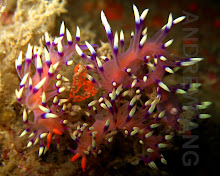
Showing posts with label DANGEROUS MARINE CREATURES. Show all posts

Sunday, January 18, 2009

Baby Scorpion Fish


These fellas are another type of ugly looking fishes. Scorpionfish are the type of fish which ambush their prey using their camouflage. They are somewhat like the Stonefish because you really have to look out for these guys while diving. Can be colorful fellas but ugly.
-AA-

Ugly Looking Stone Fish


Can you see his face? I really don't know what to say but they are really ugly. You will not find one pretty looking stone fish in the ocean as far as I know.
They have needle-like dorsal-fin spines on them as their defense mechanism. These highly camouflaged stone fishes makes them extremely dangerous to other fish as well as divers because its so difficult to spot them underwater. They look so much like a rock which is why they are called stone fishes.
How dangerous are they to divers? Extremely! Their dorsal-fin spines have toxic venom which can be fatal to humans.
I never really go to near them to take pictures. There's a reason why people should not touch anything while diving or snorkelling for their own safety.
-AA-

Wednesday, July 23, 2008

TITAN Triggerfish


Finally I got to see these brutal looking triggerfish called the Titan. This is the fish most Divers are afraid to bump into especially reproduction season. They kinda look like Marilyn Manson with the dark thick lips =P
I saw 4 adult Titan's & 1 baby Titan in total this trip to Redang Island. The Titan's are the largest of the triggerfish species and can grow up to 75 cm in length (30 inches) OR 2 and a half feet. Yes, I saw the fully grown ones which are 2 and a half feet long & they are real fat fishes, big eyes with big sharp teeth.
The fish can be very aggressive towards divers and snorkellers. Especially during reproduction season it is very territorial and will guard its nest, which it lays in a flat sandy area, vigorously against any intruders. Due to its size and strong teeth it can inflict serious injury. Bites may also be ciguatoxic.
The Titan Triggerfish will not always bite, but can swim at snorkellers and divers escorting them out of their territory. When the males (most colourful) start swimming in your direction, the best thing to do is swim away backwards kicking your fins as a defence. Failure to do so may result in being bitten.
As much as I was afraid to see these fellas, I'm glad I have seen them real life. Colorful but at the same time brutal looking creatures.
-AA-

Tuesday, July 22, 2008

ZERO CONTACT - THE BEST PRECAUTION!

!Do not touch or handle reef creatures. Be content with just observing them.
Shuffle your feet when walking in shallow water. This will alert creatures hiding on the seabed to retreat away so you don't step on them accidentally.

!Wear clothing to avoid getting stung or scratched. Stinging coral or jellyfish can only sting exposed areas of your body. If you bump against sharp coral, clothing will help minimize cuts and injuries.

!Look carefully where you are going. Some transparent jellyfish may be hard to see and that innocent rock or coral you bump into might be some reef creature in disguise.

!Maintain good buoyancy control at all times while skin-diving, snorkelling or diving. Wearing a life-jacket when snorkelling helps you to stay buoyant and avoid contact with anything on the seabed, corals or rocks.
-AA-

General Precautions

Marine creatures within the reef ecosystem have evolved different types of predatory and defensive mechanisms in order to survive such as stings, spines and venomous bites. Many of these are among the world's most venomous creatures. Animal Planet's 'Most Extreme: Venom' program included in its top 10 list the box jellyfish, stonefish, blue-ringed octopus, cone shells and sea snakes. Many of these except perhaps for the box jellyfish can be found in Redang.

Fortunately for us, these creatures are not out to attack humans. We are not their natural targets or food source and they are not naturally aggressive toward us. It is only when our presence and behaviour threatens and provokes them that we may become victims of their defenses. Most human injuries are typically a result of accidental contact with these creatures. Under normal circumstances, the natural reef is not dangerous. Most unpleasant encounters involving reef life are caused by people accidentally touching them, stepping on them or simply due to ignorant and stupid actions. We can minimize accidental contact with them by observing the general precautions shown above.
-AA-

DEFENCE MECHANISMS

With many reef predators and prey occupying the same reef habitat, many reef creatures would rather hide when threatened and employ deception, mimicry and camouflage to disguise themselves as a first line of defense. Some even show off bold, bright colours to announce that they are poisonous. Others will distract predators with inks, lights or ejected parts. When attempts to evade the attacker is futile, they will resort to different means to protect themselves, including using predatory mechanisms as a last line of defense.

Slow-moving creatures like urchins, sea stars and cone shells use chemicals or poisons in combination with darts, spines and needles to protect themselves.

Stonefish and scorpionfish carry lethal venom on dorsal spines, rays carry venom in their stings, while boxfish, pufferfish, soapfish and toadfish secrete skin poisons.
Jellyfish, corals, anemones and hydroids use stinging cells called nematocysts to fire a mass of minute harpoons containing venom to stun and kill their prey.

Some species of octopus have venom in their saliva. For example, the bite from the tiny blue ringed octopus can be lethal to humans.

Some innocent-looking reef fishes are equipped with self-defense mechanisms. Squirrelfish and angelfishes have spines on their gill-covers which are venomous in some species of squirrelfish. Surgeonfish have a retractable blade or scalpel at the base of the tail which it uses to slash would-be attackers.

Some sea cucumbers eject white cuiverian tubules when irritated. These contain toxins that can cause blindness when it comes into contact with the eye - so make sure you wash your hands after handling them. Others are able to cast off parts of their gut as sacrificial bait or emit sticky filaments to entangle would-be predators, including humans. These body parts are regenerated.
Barracudas, sharks, eels and triggerfishes have powerful jaws for biting while the mantis shrimp uses its deadly claws to spear or smash their victims. Electric rays and electric eels can deliver high-voltage electric shocks to stun its prey.
-AA-